It is late August, which means minivans across America are once again groaning under the weight of mini-fridges and Twin XL sheets. Parents are preparing to bid tearful farewells to their teenagers, alongside equally tearful farewells to roughly $300,000 in tuition. But in 2026, as families navigate the ivy-choked quadrangles of elite institutions and the sprawling campuses of state universities alike, a specter is haunting the admissions office: artificial intelligence.
For decades, the four-year university degree operated as the ultimate corporate filtering mechanism. It was a reliable, if blunt, proxy for a candidate's ability to read comprehensively, write coherently, and tolerate bureaucracy. Today, a finely tuned large language model can perform two of those three tasks instantly, and with considerably less complaining. If an AI agent can write flawless code, draft bespoke marketing copy, and pass the bar exam before it finishes its morning algorithmic coffee, what exactly are we paying the modern university to teach?
"We are witnessing the unbundling of higher education, accelerated by a technology that commoditizes basic cognitive labor," says Dr. Aris Thorne, a former university provost who now directs workforce strategy at a Fortune 100 consulting firm. "The crisis isn't that young people don't want to learn. The crisis is that the traditional curriculum is preparing them for a 2019 labor market that no longer exists."
The numbers bear out Thorne's pessimism. Since the watershed generative AI breakthroughs of the early 2020s, the corporate sector has aggressively pivoted toward skills-based hiring. A recent survey of major American employers revealed that 68 percent have dropped degree requirements for entry-level white-collar roles, relying instead on AI-driven skills assessments. Meanwhile, micro-credentials—hyper-focused, industry-sponsored certifications that take weeks rather than years to complete—have seen a 400 percent surge in enrollment. The market is speaking, and it is saying that a semester spent memorizing supply-chain theories is vastly inferior to an AI-assisted simulation of a real-time logistics crisis.
This puts traditional universities in a rather awkward position. The modern lecture hall, an architectural marvel designed to facilitate the one-way transfer of information from a solitary expert to a sea of passive listeners, is fundamentally obsolete. Watching a professor read slides to students who possess an omniscient AI tutor in their pockets feels a bit like teaching someone to churn butter in the aisle of a Whole Foods. It is quaint, it is artisanal, and it is entirely unnecessary for survival.
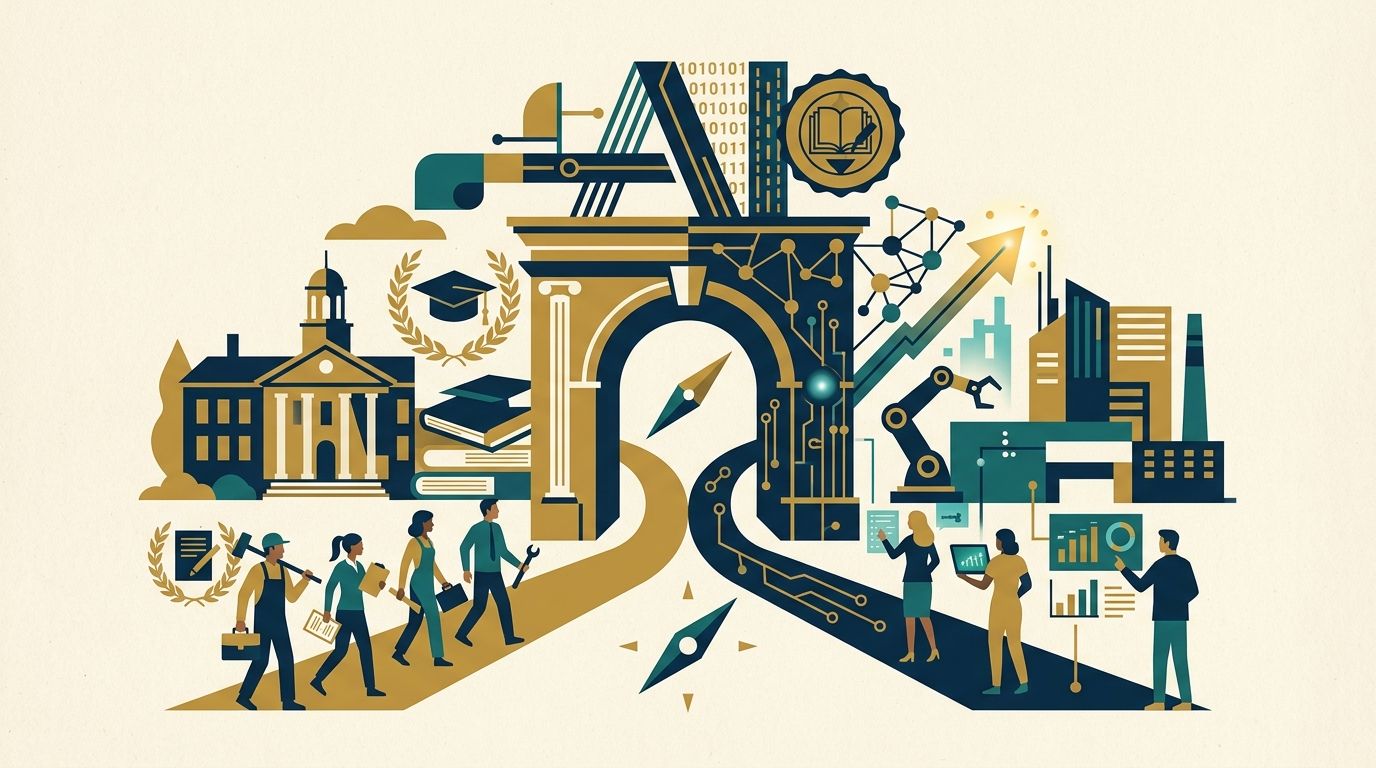
Yet, to declare the death of the college experience would be premature. Higher education is not ending; it is bifurcating. The institutions that survive this crossroads are rapidly mutating from mere knowledge dispensaries into what we might call "cognitive finishing schools." If AI handles the rote mechanics of production—the coding, the drafting, the data sorting—then the premium human skills of the 2030s will be judgment, ethics, curation, and complex problem-solving.
Progressive universities are already redesigning their curricula to reflect this reality. They are abandoning the traditional term paper in favor of "AI audits," where students are graded not on generating an essay, but on critiquing and refining the output of three different AI models. Engineering students are no longer just writing syntax; they are acting as systems architects, managing swarms of AI coding agents to build enterprise-scale software in a single semester. The campus is becoming a laboratory for human-machine collaboration, a safe sandbox where students learn to manage the digital labor force they will oversee upon graduation.
As America's workforce stands at this crossroads, the value of college will no longer be measured by the knowledge a student acquires, but by the wisdom they develop in directing the machines that hold all the knowledge. The minivans will still arrive next August, and the tuition checks will still clear. But the diploma waiting at the end of four years will represent something entirely new: not a certification of what a student knows, but a testament to how well they can navigate a world where knowledge is practically free.